EN
 es
 ru
 CN

Choosing the right flexi tank container starts with the cargo—not with tank capacity alone. Before selecting a system, confirm the liquid type, density, loading temperature, required volume, food-contact requirements, chemical compatibility, discharge conditions, and shipping route.
For most international shipments, flexi tank containers are installed inside standard 20ft dry containers and used for compatible non-hazardous liquids. BLT offers different systems for food-grade liquids, chemicals, wine, high-temperature cargo, and other specialized applications rather than applying one flexitank specification to every liquid.
The supplier should know at least six things:
| Selection Factor | Why It Matters |
|---|---|
| Cargo name | Determines basic compatibility |
| Density | Determines safe loading volume and weight |
| Loading temperature | Affects film and valve selection |
| Required volume | Determines flexitank capacity |
| Food or chemical application | Affects material and certification requirements |
| Transport route | May affect container, carrier and temperature requirements |
Providing only the cargo name is often not enough.
For example, two oils may have different densities, viscosities or loading temperatures and therefore require different flexitank configurations.
Capacity should be selected according to both volume and cargo density.
BLT offers flexitanks in multiple capacities. Its FAQ notes that under COA-related requirements, standard 20ft GP flexitank loading should generally not exceed 24 kL or 24 metric tons, while larger capacities require appropriate carrier approval.
Use:
Cargo weight = volume × density
For example:
22,000 L × 1.08 kg/L = 23,760 kg
In this case, choosing a 24,000-liter flexitank simply because it is larger may not be appropriate.
The objective is not to install the largest available tank. It is to maximize payload within the permitted weight and operating conditions.
Different liquids create different technical requirements.
Edible oils, juice concentrates, syrups and other food ingredients generally require food-contact-grade films and valves.
BLT food-grade systems use PE film and woven PP construction and are available in configurations for standard 20ft containers, with a stated working temperature range of approximately -20°C to +60°C.
For food cargo, buyers should also review relevant food-contact and hygiene documentation.
Chemical cargo requires more attention to compatibility.
The flexitank film, valve, seals and other cargo-contact components must be suitable for the specific liquid. BLT's chemical flexitank systems use specialized films and corrosion-resistant valves for compatible non-hazardous chemicals.
An SDS and detailed cargo specification should be provided when compatibility is uncertain.
Some oils, bitumen-related products and viscous liquids may need to be loaded at elevated temperatures.
A standard flexitank should not automatically be used.
BLT's heat-resistant flexitank, for example, is designed for working temperatures from approximately 60°C to 120°C, using specialized film and high-temperature-resistant valve components.
Temperature must therefore be confirmed before loading, not after the flexitank reaches the filling site.
Yes. Material selection directly affects cargo compatibility and transport reliability.
A typical system uses:
PE inner films for liquid containment
Woven PP outer material for mechanical support
Compatible filling/discharge valves
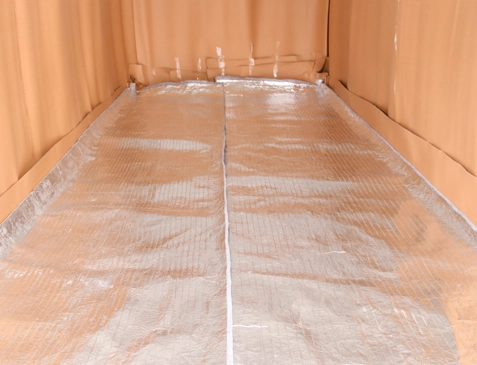
Container protective lining
Bulkhead and restraint components
For specialized cargo, additional barrier, temperature-resistant or chemical-resistant properties may be required.
The number of film layers alone should not determine your purchasing decision. The complete system—including films, valves, seals, bulkhead and container preparation—must match the cargo.
Even the correct flexitank can be compromised by an unsuitable shipping container.
Before installation, the 20ft container should be checked for:
Sharp projections
Damaged flooring
Rust or structural damage
Contamination
Door defects
Surfaces that could abrade the flexitank
Protective materials and the restraint system must then be correctly installed.
A flexi container solution should therefore be viewed as an integrated system: the flexitank and shipping container work together to contain and restrain thousands of liters of moving liquid.
No.
Standard flexi containers are primarily intended for compatible non-hazardous liquids.
Typical cargoes include:
Edible oils
Wine and beverages
Juice concentrates
Glycerin
Glycols
Latex
Base oils
Lubricants
Compatible non-hazardous chemicals
BLT states that its systems cover a wide range of non-hazardous food, oil and chemical cargoes, with specialized configurations available where transport conditions require them.
Cargo compatibility should always be confirmed before shipment, particularly for chemicals, solvents, high-temperature liquids or unfamiliar formulations.
Before approving a quotation, confirm:
Recommended capacity and maximum payload
Film and outer-layer construction
Cargo compatibility
Valve specification
Loading temperature range
Bulkhead and accessories included
Required 20ft container condition
Installation instructions or service
Applicable test and compliance documentation
This makes comparisons between suppliers more meaningful than simply comparing price per bag.
A lower-priced flexitank that does not match the cargo density, temperature or chemical properties can create substantially higher costs if leakage, contamination or discharge problems occur.
Selecting the right flexi tank container is primarily a cargo-matching decision.
Start with the liquid type, density, loading temperature and required volume, then select the appropriate film, valve, capacity and restraint system. Food liquids, chemicals and high-temperature cargo should not automatically use the same specification.
For B2B buyers, the safest approach is to provide the flexitank supplier with complete cargo and route information before requesting a final configuration.
The right system is not simply the largest or lowest-cost flexitank—it is the system engineered for the actual cargo and transportation conditions.
Standard flexitank systems are primarily installed in 20ft general-purpose containers. BLT's standard food and chemical flexitank specifications also identify the 20ft container as the normal carrier.
Capacity varies, but BLT offers multiple sizes and advises selecting capacity according to cargo density and permitted loading weight.
Standard flexitanks are intended for compatible non-hazardous liquids. Hazardous cargo requires an approved transport solution appropriate to its classification.
Flexi tanks containers is commonly used as a search variation for flexitank systems installed inside shipping containers. The more standard industry terms are "flexitank" or "flexi tank container."
A container flexi system generally refers to a flexible liquid tank installed inside a shipping container together with the necessary lining, valve and restraint components.
Provide the supplier with the cargo name, density, volume, loading temperature, route and any food-grade or chemical requirements so the appropriate system can be selected.